



Available Equipment at the DNA and Microbe Biofoundry
The Sorbonne University Alliance Biofoundry, also known as the DNA and Microbe Biofoundry within the Paris Biofoundry, is equipped with advanced tools and technologies designed to streamline DNA assembly, microbial transformation, and high-throughput screening. Our state-of-the-art instruments support diverse research projects, enabling precision genetic engineering and comprehensive phenotyping of microorganisms such as bacteria, yeast, and microalgae.
Below is a list of the most important equipment available at our facility, providing researchers with the capabilities necessary to advance innovations in synthetic biology and microbial engineering:
Available Equipment at the DNA and Microbe Biofoundry
The Sorbonne University Alliance Biofoundry, also known as the DNA and Microbe Biofoundry within the Paris Biofoundry, is equipped with advanced tools and technologies designed to streamline DNA assembly, microbial transformation, and high-throughput screening. Our state-of-the-art instruments support diverse research projects, enabling precision genetic engineering and comprehensive phenotyping of microorganisms such as bacteria, yeast, and microalgae.
Below is a list of the most important equipment available at our facility, providing researchers with the capabilities necessary to advance innovations in synthetic biology and microbial engineering:

HPLC-NanoLC-MS
A mass spectrometer coupled to high-performance liquid chromatography and nano-liquid chromatography, enabling ultra-sensitive analysis of complex biological mixtures. It provides high-resolution separation of peptides and small molecules prior to ionization and mass spectrometric detection. This instrument is particularly well suited for proteomics, metabolomics, and both targeted and untargeted analyses. Its high mass accuracy and resolution allow reliable identification and quantification of low-abundance compounds. It is a key tool for functional and systems-level biological studies.
CD7 Confocal microscope
A state-of-the-art confocal microscope enabling high-resolution 3D imaging of biological samples. It uses laser scanning to eliminate out-of-focus light and generate optically sectioned images. Particularly well suited for live-cell imaging and the analysis of fluorescent subcellular structures. It offers exceptional spatial resolution and supports multi-channel acquisitions for the simultaneous labeling of multiple targets. Ideal for advanced fluorescence microscopy in cell biology and microbiology.


Echo 650T ultrasonic liquid transfer
A contactless liquid transfer system using acoustic technology to dispense volumes ranging from nanoliters to microliters. It eliminates the need for pipette tips, thereby reducing consumable costs and minimizing the risk of cross-contamination. The system enables high-throughput screening with exceptional precision for assay plate preparation and serial dilutions. It is particularly well suited for applications in drug discovery, functional genomics, and NGS sample preparation. Acoustic technology ensures high reproducibility, even when handling viscous or volatile liquids.
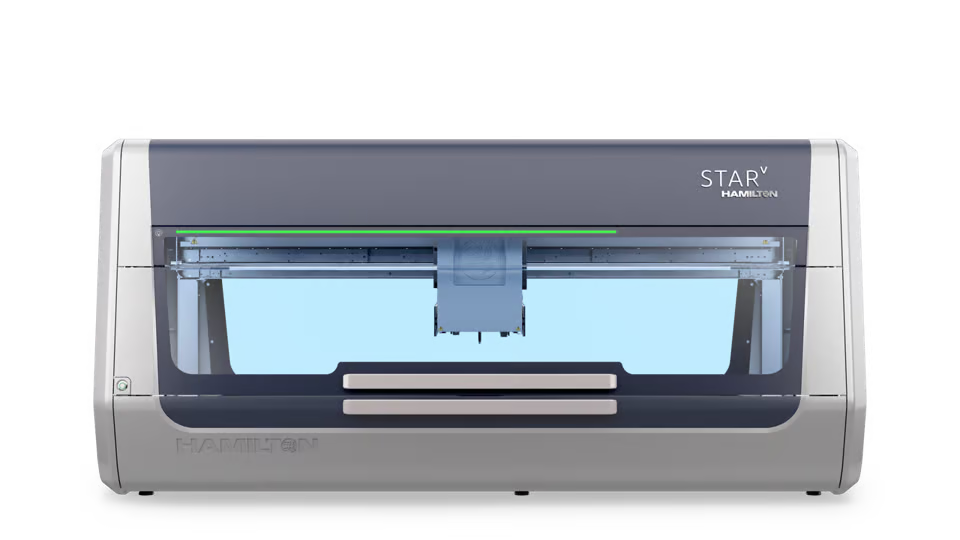
Star V Robotic Pipette
A modular robotic workstation designed for the automation of pipetting and liquid handling operations. It is equipped with programmable robotic arms and multichannel pipetting heads to process multiple samples simultaneously. The system enables full automation of complex workflows, including dilutions, transfers, mixing, and plate dispensing. It integrates with a wide range of peripheral modules (plate readers, incubators, automated storage) to build end-to-end analytical pipelines. This platform significantly reduces human error and increases throughput in high-activity laboratory environments.

Miro Canvas
A collaborative digital platform for visualizing and managing laboratory workflows. It allows users to create interactive diagrams, map experimental processes, and document protocols in real time. It facilitates teamwork with collaborative sharing and annotation features for project planning. It integrates project management tools tailored to research environments to track experimental progress. It improves traceability and communication among team members on complex projects.
Nanopore Sequencer
A portable DNA/RNA sequencer using nanopore technology for real-time sequencing. It detects changes in electrical current as nucleotides pass through protein pores to identify sequences. It generates ultra-long reads (>100 kb) without prior amplification, preserving native epigenetic modifications. It offers high flexibility with formats ranging from portable MinION to high-throughput PromethION, depending on the requirements. It enables direct RNA sequencing and base modification detection, revolutionizing field genomics.


Multidrop dispenser
Automated reagent dispenser for the rapid and reproducible dispensing of identical volumes into multi-well plates. Uses single-use, disposable cartridges to prevent cross-contamination between different reagents. Capable of dispensing from a few microliters to several milliliters per well with excellent accuracy and repeatability. Particularly suitable for adding buffers, culture media, and assay reagents in 96, 384, or 1536-well formats. Significantly accelerates plate preparation for screening, cell cultures, and enzyme assays.
BlueWasher
Automated reverse centrifugation microplate washing system for ELISA, immunoassay, and cell screening applications. Performs precise washing cycles with controlled supernatant removal and distribution to efficiently eliminate unbound reagents. Programmable for various protocols with adjustable volumes, number of cycles, and soaking time. Reduces inter-well variability and improves result reproducibility compared to manual washing. Compatible with 96- and 384-well plates, essential for standardizing critical washing steps in immunology.


BTX Gemini x2 96 wells electorporator
Multichannel electroporator enabling the simultaneous transfection of 96 plate-sized samples. Uses controlled electrical pulses to create temporary pores in cell membranes and introduce DNA, RNA, or proteins. Offers optimized protocols for various cell types (bacteria, yeast, mammalian cells, algae) with precise control of voltage, pulse duration, and number of pulses. Enables high-throughput screening of transformation conditions or parallel genome editing of multiple strains. Dramatically increases the efficiency and throughput of molecular biology experiments requiring the introduction of genetic material.

20L Photo-bioreactor
From Synoxis Algae, it is called LUCY. It is a tubular system that uses bubble lift technology to ensure mixing. It operates at temperatures ranging from 15 to 35°C and is pH-controlled by CO2 sparging. The light intensity can reach up to 600 µmol/m²/s, with a customizable light regime. Growth is monitored using a density meter at 880 nm.
Emulsiflex
It is from Avestin, model C3, and is a homogenizer designed to break cells in suspension using a French press-like system. It can operate at pressures up to 2000 psi, lysing cells with minimal oxidation, as there is no air contact with the sample, and with minimal heating. The sample volume ranges from 10 mL to approximately 200 mL.


Cell Sorter
This is the 4-laser version of the CytoFLEX SRT from Beckman. It has a 100 µm aperture, so cells larger than 50 µm are not accepted to prevent clogging. It sorts from 5 mL tubes (down to 1 mL is possible) into a pre-filled 96-well plate or 4 tubes. Sorting is based on forward and side scattering, as well as fluorescence (Ex: 405, 488, 561, 638 nm / Em: 450/45, 525/40, 585/42, 610/20, 660/10, 675/30, 690/50, 710/50, 712/25, 780/60 nm)
QPCR
This equipment is used for fluorescence-based quantitative PCR. It is a CFX Opus 96 from Bio-Rad (CH1: 450-490 nm / 515-530 nm, CH2: 515-535 nm / 560-580 nm, CH3: 560-590 nm / 610-650 nm, CH4: 620-650 nm / 675-690 nm, CH5: 672-684 nm / 705-730 nm) and is compatible with most commonly used fluorophores.


Opentrons
An open-source pipetting robot equipped with an 8-channel pipette and 11 SBS deck positions to automate simple and standard protocols. It features a vacuum system for column-based purifications. The robot is compatible with standard labware and has flexible software, including a Python API, making it highly customizable. It can quickly fill a 96-well plate in as little as 22 seconds, ensuring high throughput for various laboratory applications.
Fluorescence kinetics
The Walz Imaging PAM Maxi is a versatile system for chlorophyll fluorescence analysis, providing detailed insights into photosynthetic efficiency. It uses a 450 nm excitation wavelength and supports pulse-modulated excitation and actinic light for precise photosynthetic measurements. The camera used is the IMAG-K6 CCD camera, which features a 2/3″ sensor with a resolution of 1392 x 1040 pixels, offering high sensitivity and image quality for fluorescence imaging. This setup is ideal for analyzing spatial and temporal variations in photosynthetic activity


Colony Picker
It’s a QPIX 420 from Molecular Devices, equipped with a camera to select colonies based on white light or fluorescence. It supports various types of pins to adapt to different colony textures and can restreak colonies onto up to two destination plates, organized either in agar or 96-well formats. The system senses agar height and is compatible with both Omnitrays and circular 90 mm plates.
Biolistic
It’s a Bio-Rad PDS-1000/He, which shoots 0.6 µm high-velocity gold particles onto a petri dish under vacuum. This system can be used for both organellar and nuclear genetic transformation. We currently use 1100 psi rupture disks, but other options ranging from 450 to 1800 psi are available for purchase.


Electroporator
We have several electroporators, ranging from the classic Gene Pulser II from Bio-Rad to the Neon NXT from Thermo Fisher and the Nepa21 from NepaGene. Each system has its own specific features in terms of volume capacity, pulse types, and voltage settings, ensuring that one of them will meet your needs.
· Gene Pulser II (Bio-Rad): Handles sample volumes from 40 µL to 400 µL, with voltage settings ranging from 200 to 3000 V. It offers both exponential decay and square-wave pulse modes for flexibility across different electroporation needs.
· Neon NXT (Thermo Fisher): Designed for very small volumes (down to 10 µL), with customizable pulse width and pulse number. It delivers up to 2500 V, making it highly efficient for electroporating difficult-to-transfect cells.
· Nepa21 (NepaGene): Provides precise control with both high-voltage (up to 2000 V) and low-voltage pulses, capable of applying both positive and negative voltages. It supports volumes from 10 µL to 100 µL, ideal for complex transfections, including delicate cell types.
Cell Counter
This is a Countess II FL from Thermo Fisher, designed for automated cell counting using a dedicated reusable slide and camera-based recognition. It operates on white light, GFP, and Cy5 channels, making it versatile for various cell types. The system is user-friendly, with tunable detection intensity thresholds, roundness, and size parameters to ensure accurate cell counting.
